
No parking
Hydrant
Usually marked with:red curb on both sides of the hydrant.
Your fire code sets how far the red curb extends.
 Illustrative image
Last updated November 13, 2026
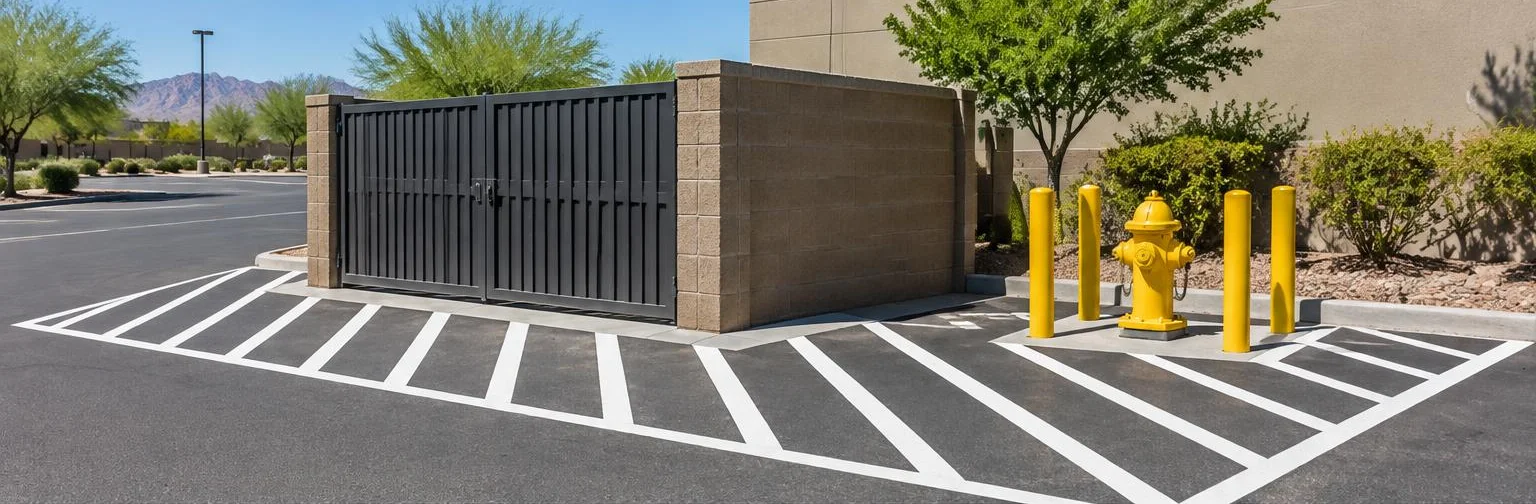
The 2010 ADA Standards require access aisles to be marked so people won't park in them (§502.3.3). Define hatched no-parking zones at hydrants, crosswalks, trash enclosures, loading areas and accessible aisles. A local contractor can align markings with your approved plan and city requirements.
Five spots where a parked car blocks access, and how each one is usually marked.
Usually marked with:red curb on both sides of the hydrant.
Your fire code sets how far the red curb extends.
Usually marked with:white crosswalk bars, often with a stop bar.
Keep the crosswalk and the curb ramps at both ends clear.
Usually marked with:yellow hatching or a NO PARKING stencil.
The collection truck needs a straight, open approach.
Usually marked with:yellow hatching, a stencil and a sign.
Time limits are set by the property and posted on the sign.
Usually marked with:diagonal hatching beside the accessible space.
The aisle must stay open for ramps and wheelchairs.
Planning illustration, not a site plan. Verify dimensions, signs and local requirements before work.
A local contractor. A scope built around your property.
Diagonal hatching tells drivers an area is not a parking space; curb paint and stencils add a clear message at the edge; signs explain rules that paint can't, like time limits or towing. Most no-parking areas work best with two of the three.
When a lot is restriped, it's tempting to add a stall where a hatch used to be. Before any hatched area becomes parking, check that it isn't an accessible aisle, a fire lane, a hydrant clear space or a loading area the property needs.
For no-parking zone striping, compare material and surface conditions for hydrant zones and crosswalk buffers.
Read the guideRequest an itemized no-parking zone striping scope covering hydrant zones and crosswalk buffers.
Read the guide Cost estimatorCoordinate no-parking zone striping work on hydrant zones and crosswalk buffers with operating hours and reopening requirements.
Read the guideReview the no-parking zone striping scope for hydrant zones and crosswalk buffers with your contractor before approving the quote.
Read the guideOnly if it isn't required for something else, like an ADA access aisle or a fire lane. Check before painting.
It varies by property and city. ADA access aisles need markings that discourage parking; fire lanes follow the fire department's detail.
Send your address, photos, approximate size, operating hours and target date. Include inspection notes or plans, especially for hydrant zones, crosswalk buffers, trash access. Valley Lot Striping connects you with a contractor; it does not perform the work.
No-Parking Zone Striping can include hydrant zones; crosswalk buffers; trash access; loading zones; ada aisles; diagonal hatching.
Define hatched no-parking zones at hydrants, crosswalks, trash enclosures, loading areas and accessible aisles. A local contractor can align markings with your approved plan and city requirements.
 Illustrative image
Truck courts, dock lines and trailer stalls outside; forklift aisles inside.
Learn more Illustrative image
Bus loops, parent pickup lanes, crosswalks and staff lots striped before the school year starts.
Learn more Illustrative image
Large weekend lots, accessible spaces near the entrances, and drop-off lanes.
Learn moreCommercial lots and facilities across 14 Phoenix Valley and Pinal County service areas.
Tell us what your commercial property needs. We’ll connect you with a licensed local contractor for a project-specific quote.